















written by Dr. Gerardo Perez-Camargo, DVM, Ph.D.
Puppy food is formulated for growth: more calories and fat, a higher minimum protein level, added DHA, and tightly controlled calcium and phosphorus. Adult food is formulated for maintenance, with fewer calories, a lower minimum protein level, no DHA requirement, and a wider mineral range.
Below, we cover the exact nutrient differences and answer the two questions that tend to come up in the same breath: Can a puppy eat adult food, and can an adult dog eat puppy food? For the full picture on feeding amounts, frequency, and when to switch, see our complete puppy nutrition guide.
Puppy and adult dog food differ in four concrete ways: calorie density, minimum protein level, DHA inclusion, and how tightly calcium and phosphorus are controlled. Growth formulas are also set slightly higher in several other minerals, including sodium, iron, copper, manganese, zinc, and selenium, but the differences below are the ones with the biggest practical impact on your dog.
Here’s how those differences look side by side:
| Nutritional factor | Puppy food (growth) | Adult food (maintenance) |
|---|---|---|
| Calories & fat | Higher, to fuel rapid growth (fat minimum 8.5% DMB) | Moderate, for weight maintenance (fat minimum 5.5% DMB) |
| Minimum protein (AAFCO, dry matter basis) | 22.5% | 18.0% |
| DHA (with EPA) | Required minimum, to support brain and vision development | Not a required nutrient |
| Calcium range (AAFCO, dry matter basis) | 1.2%–1.8% (tighter ceiling, critical for large breeds) | 0.5%–2.5% (wider range) |
| Adequacy statement to look for | “Growth,” “Growth and Reproduction,” or “All Life Stages” | “Adult Maintenance” |
On protein, the growth minimum is about 25% higher than the adult minimum—22.5% versus 18.0% on a dry matter basis—because building new tissue takes more protein than maintaining it.
The calcium and phosphorus difference is the most clinically important, and it’s a bit more nuanced than “puppies get a maximum and adults don’t.” Both profiles actually set a minimum and a maximum for calcium. The key is that the growth profile’s ceiling is much tighter: a maximum of 1.8% calcium on a dry matter basis, versus 2.5% for adult maintenance. That tighter cap exists because during growth, both too little and too much calcium can cause serious, permanent skeletal problems. This is a risk that’s especially high for large- and giant-breed puppies, whose bones develop over a longer window. Adult dogs have finished growing, so their profile allows a wider range.
The practical shortcut is the nutritional adequacy statement on the label. A food labeled for “Growth,” “Growth and Reproduction,” or “All Life Stages” meets a puppy’s needs; a food labeled only for “Adult Maintenance” does not. (These figures come from AAFCO’s official Dog Food Nutrient Profiles.)
As an ongoing diet, no. Adult food doesn’t provide the calorie density, higher minimum protein, or DHA a growing puppy needs, and it isn’t formulated with the tightly controlled calcium and phosphorus levels that support steady, healthy skeletal development. This matters most for large- and giant-breed puppies, where the goal is optimal rather than maximal growth — steady skeletal development rather than the fastest possible growth rate.
That said, an occasional bite isn’t dangerous. The real concern is adult food becoming a regular part of a puppy’s diet.
If your puppy has been eating adult food regularly, it’s worth checking in with your veterinarian and switching to a growth-appropriate (or all-life-stages) formula.
An adult dog should not eat puppy food as a regular diet. Puppy food’s higher calorie density, higher protein, and elevated mineral levels are matched to a growing puppy, not an adult dog. Fed long-term, it can contribute to unwanted weight gain and supply more of certain nutrients than an adult dog needs.
An occasional meal won’t harm a healthy adult dog, but it isn’t an appropriate everyday diet.
There’s one common workaround worth knowing. Some households feed an “All Life Stages” formula, which is formulated to be appropriate for both puppies and adults and can simplify feeding in a multi-dog home. One caveat: If a large- or giant-breed puppy is in the mix, check that the all-life-stages food also states it’s suitable for “growth of large size dogs (70 lbs. or more as an adult),” since not all of them are.
Most dogs make the switch between roughly 9 and 24 months, and breed size is the biggest factor. Small and medium breeds are usually ready around 9–12 months, while large and giant breeds stay on growth formula considerably longer—often 18 to 24 months—because their skeletons take longer to finish developing.
For the complete breed-by-breed timeline, how spay/neuter timing fits in, and the step-by-step transition method, see our complete puppy nutrition guide.
Puppy food has more calories, a higher minimum protein level (22.5% versus 18.0% on a dry matter basis, per AAFCO), added DHA, and more tightly controlled calcium and phosphorus. Adult food is formulated for maintenance rather than growth, with fewer calories and a wider mineral range.
Not as a regular diet. Adult food lacks the calorie density, protein level, and DHA a growing puppy needs, and its mineral levels aren’t tuned for skeletal development. An occasional taste isn’t harmful, but it shouldn’t replace a growth-formula (or all-life-stages) diet.
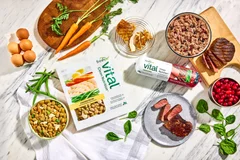
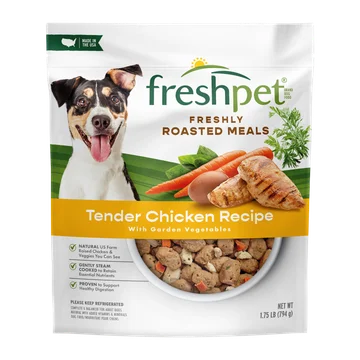
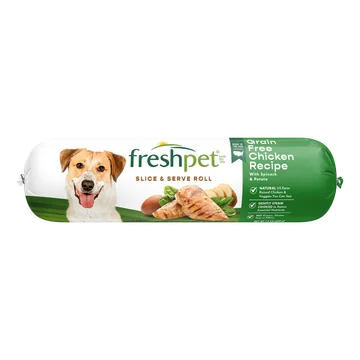
Adult dogs can be fed a food labeled for “all life stages,” which is formulated to be complete and balanced for both puppies and adults. Freshpet’s Vital range, for example, is all life stages. The main thing to keep in mind is that foods formulated for growth are more calorie-dense, so it’s important to adjust feeding quantities to keep your adult dog at an ideal body condition. A food labeled for growth (puppy) only is still best matched to a growing puppy, but an occasional meal won’t harm a healthy adult.
Generally between 9 and 24 months depending on breed size, with small and medium breeds switching earlier and large and giant breeds staying on growth formula longer. See our complete puppy nutrition guide for the full breed-by-breed timeline and transition method.


cat pet parents
Join us as we cover the fascinating reasons why cats get the "nighttime zoomies."

pet wellness
Living in an apartment with a dog? Explore simple ways to exercise your dog, keep them entertained indoors, and help them thrive in small spaces.